

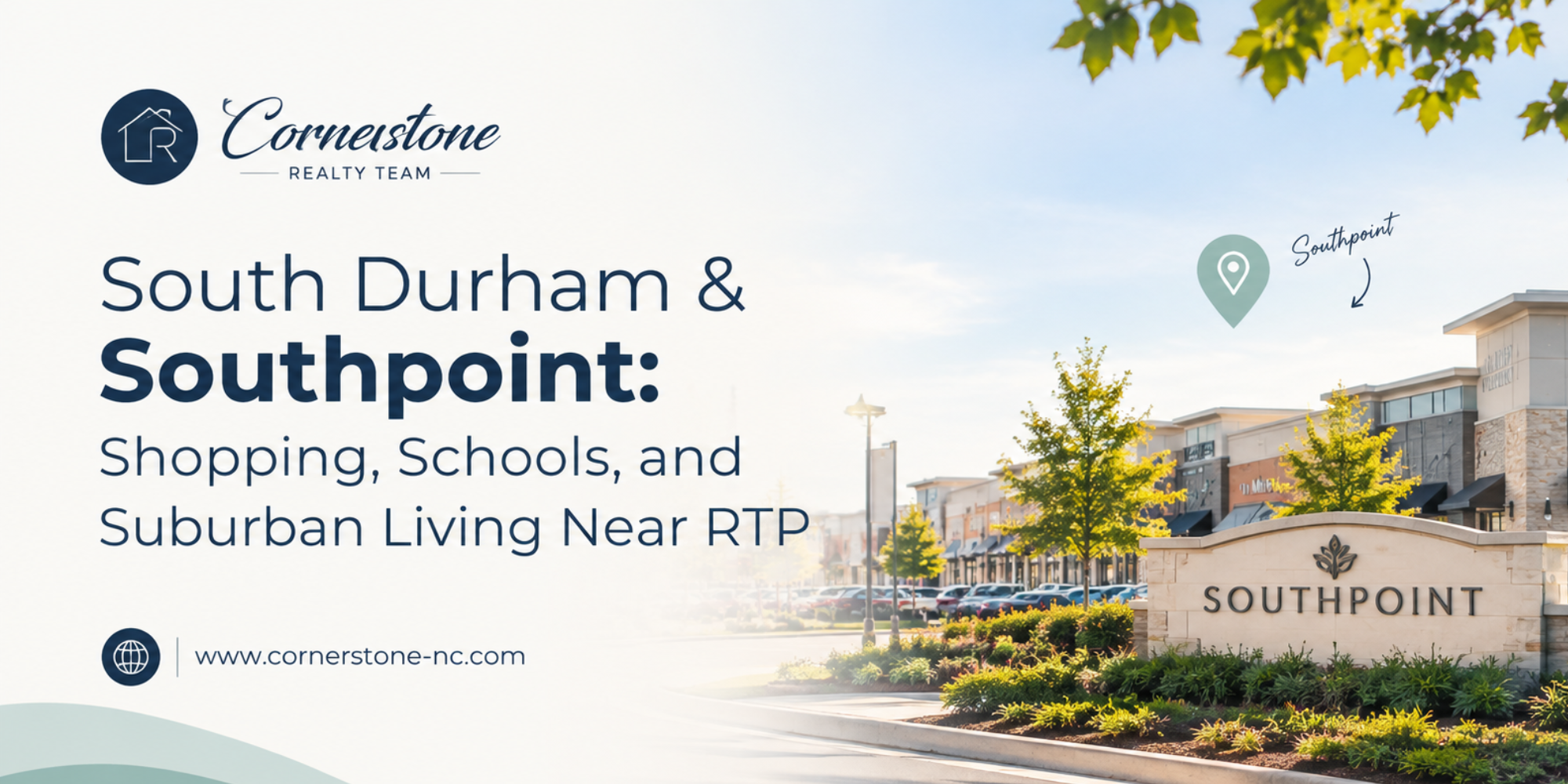
If Trinity Park and Duke Park represent Durham’s historic, walkable core, South Durham — anchored by the Southpoint area — is the city’s suburban counterweight. It’s where a lot of RTP employees, young families, and move-up buyers end up once they’ve compared commute times, school options, and square footage against the price of an in-town bungalow. Here’s what you need to know if South Durham is on your list.
Where “South Durham” Actually Is
South Durham isn’t a single subdivision — it’s a broad area south of I-40, roughly bounded by NC-751 and Fayetteville Street, that includes established communities like Woodcroft, Hope Valley, Parkwood, and the newer developments clustered around The Streets at Southpoint mall. When buyers say they want to be “near Southpoint,” they usually mean this general corridor rather than one specific neighborhood, which is part of why it’s worth understanding the sub-areas separately before you start touring.
Woodcroft is one of the more established communities in the area, popular with buyers who want mature landscaping, a mix of housing styles, and easy access to the American Tobacco Trail. Hope Valley sits closer to the historic Hope Valley Country Club and tends to run toward larger, higher-end homes on wooded lots. Parkwood is generally more affordable and appeals to first-time buyers who still want the South Durham location without the premium. Newer master-planned communities near the mall itself — places like Jordan at Southpoint and The Hills at Southpoint — offer contemporary construction and HOA-maintained amenities, at a price point that reflects the newer build.
What Draws Buyers to This Area
The commute. South Durham sits within about 15 minutes of RTP, Duke, downtown Durham, and downtown Chapel Hill, and it’s roughly 20 minutes from RDU. For a dual-career household where one person works in RTP and the other commutes toward Chapel Hill or downtown Durham, this location often makes more sense on a map than either downtown option alone.
The shopping and dining. The Streets at Southpoint is one of the largest retail and dining hubs in the Triangle, and its presence has pulled in a steady stream of restaurants, grocery options, and services nearby — which matters more than it sounds like for day-to-day convenience once you’re not living downtown.
The housing mix. Unlike the historic core, where inventory skews toward smaller lots and older construction, South Durham offers a genuine range — condos and townhomes in the low $300,000s up through executive single-family homes well north of $900,000 in communities like The Hills at Southpoint. That range means the area works for first-time buyers and move-up buyers alike, which isn’t true of every Durham submarket.
Green space. The American Tobacco Trail runs through the area and connects to Piney Wood Park, giving residents walkable and bikeable access to green space that’s harder to come by inside the beltline.
Schools
South Durham is zoned for Durham Public Schools, and like most of Durham, families here have both their base-assigned school and access to DPS’s magnet and year-round programs through the district’s lottery process. Because zone lines can split streets within the same subdivision, don’t assume a school assignment based on the neighborhood name alone — always confirm the specific address using DPS’s official school locator before writing an offer, especially if a particular school is a deciding factor.
Who South Durham Is Right For
This area tends to be the right call for buyers who want:
- A shorter commute to RTP or Duke than most in-town Durham neighborhoods offer
- More house and lot for the money than comparable inside-the-beltline options
- Easy access to shopping, dining, and the American Tobacco Trail
- A range of price points within the same general location, from townhomes to executive homes
It’s a less obvious fit for buyers who specifically want historic architecture, walkable urban density, or a short walk to downtown Durham’s restaurant scene — that’s Trinity Park and Duke Park territory, not Southpoint.
Buying in South Durham? Start With a Plan.
The range of inventory in South Durham — from $300,000 townhomes to $1M+ golf-adjacent estates — means “South Durham” can mean very different budgets and very different neighborhoods depending on what you’re comparing. Before you tour, it’s worth getting clear on financing, timeline, and what trade-offs matter most to you.
Download the Triangle Buyer Playbook — a step-by-step guide to buying in the Triangle market, covering financing, offer strategy, and what to expect at each stage, built specifically for Durham and Orange County buyers