
Priced Out of Durham or Chapel Hill? Why Buyers Are Looking West to Hillsborough, Mebane, and Burlington
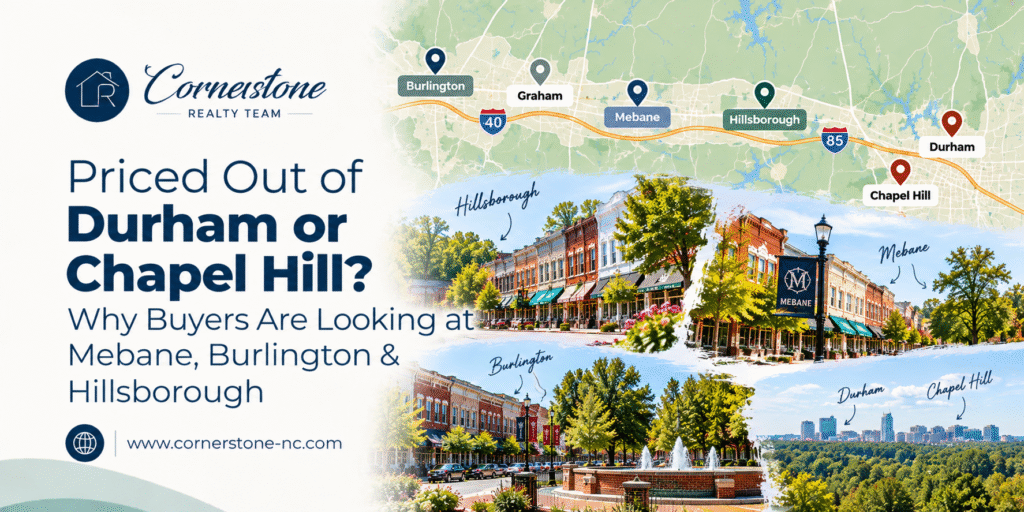
It’s one of the most common conversations we have with buyers right now. They’ve been looking in Durham or Chapel Hill, they’ve run the numbers, and what they can afford isn’t what they pictured: less space, an older home than they wanted, or a longer list of compromises than they’re comfortable with. The good news is that the Triangle doesn’t end at the Durham County line. Head west along I-40/85 and you hit a string of towns (Hillsborough, Mebane, Graham, and Burlington) where your budget stretches further, the commute is still realistic, and there’s genuine small-town character. This isn’t a “move here, everything’s cheaper” pitch. There are real trade-offs, and we’ll be upfront about them. But for a lot of buyers, the western corridor is the answer they didn’t know they were looking for. The Western Corridor at a Glance Here’s the lay of the land, moving east to west from Durham: Hillsborough (Orange County): The historic Orange County seat, about 20 minutes from Durham and Chapel Hill. Walkable downtown, strong sense of place, lots of new construction on the edges. Read our Hillsborough guide. Mebane (Alamance and Orange County): One of the fastest-growing cities in the state, sitting right on the Alamance/Orange line. Read our Mebane guide. Graham (Alamance County): The Alamance County seat, with a classic courthouse square. Graham grew faster than any other Alamance municipality between 2023 and 2025, adding nearly 10% to its population. Burlington (Alamance County): The largest city in Alamance, with around 61,000 residents. More established neighborhoods, more inventory, and the most affordable price points on the corridor. Also home to LabCorp’s headquarters and Alamance Regional Medical Center. Alamance County as a whole added about 7,000 residents between 2023 and 2025. People have noticed. What Your Budget Buys The numbers tell the story. Through August 2026, the median sale price in Orange County was $560,000, up about 12% from last year. In Alamance County, it was $325,000, essentially flat year over year. That’s a gap of roughly $235,000 at the median, and it widened this year. (Source: Doorify MLS, year-to-date through August 2026.) Within the corridor, the pattern we see consistently: Hillsborough prices sit closest to Durham, Mebane sits in the middle, and Burlington and Graham offer the biggest step down in price. New construction is a big part of the story in Hillsborough and Mebane specifically, while Burlington and Graham offer more established neighborhoods and resale homes. In practical terms, a budget that gets you a smaller or older home in Durham or Chapel Hill can often get you more square footage, a newer home, or a bigger lot as you move west. Property Taxes: Don’t Skip This Part Home prices get all the attention, but property taxes are a cost you’ll pay for as long as you own the home, and they vary a lot across this corridor. In North Carolina, your bill is your county rate plus your city or town rate (plus any special district). FY2026-27 combined rates, per $100 of assessed value, with an estimate for a home assessed at $400,000. Location County Combined rate Est. annual tax on $400K Carrboro (incl. school district tax) Orange $1.3937 ~$5,575 Chapel Hill (incl. school district tax) Orange $1.3284 ~$5,314 Hillsborough Orange $1.1935 ~$4,774 Mebane (Orange side) Orange $1.0505 ~$4,202 Mebane (Alamance side) Alamance $0.864 ~$3,456 A few things jump out. Alamance County’s county rate ($0.494) is well below Orange County’s ($0.6805), and Alamance held its rate flat this year while Orange raised its rate by about 4 cents. Burlington and Graham also sit on Alamance’s lower county rate, with their own city rates added on top. Chapel Hill and Carrboro carry an extra special district tax that funds Chapel Hill-Carrboro City Schools, which is part of why they’re the highest in the region. Remember that the tax is calculated on the county’s assessed value, which may not match what you pay for the home. Look up the actual parcel’s assessed value when you’re comparing specific houses. Schools: Know Which District You’re In The western corridor spans three different public school systems, and the differences matter: Orange County Schools serves Hillsborough and the Orange County side of Mebane. This is not the same district as Chapel Hill-Carrboro City Schools, a mix-up we see all the time. Alamance-Burlington School System (ABSS) serves Burlington, Graham, Elon, and the Alamance side of Mebane. Chapel Hill-Carrboro City Schools serves Chapel Hill and Carrboro. If this district is non-negotiable for your family, the western corridor generally isn’t the answer. As always, confirm the assignment for a specific address directly with the district. Our school zones guide goes deeper on the local districts. The Commute Reality Check Approximate off-peak drive times. From Duke / Downtown Durham UNC Chapel Hill RTP RDU Airport Hillsborough 20 min 20 min 30 min 30 min Mebane 25–30 min 25–30 min 35–40 min 35–40 min Graham 35 min 35 min 45 min 45 min Burlington 35–40 min 35–40 min 45–50 min 45–50 min Those numbers can grow a lot at rush hour, especially on eastbound I-40/85 in the morning. If you work at Duke or UNC, Hillsborough and Mebane are very livable daily commutes. If you work in RTP, Raleigh, or near RDU five days a week, be honest with yourself about the drive. For hybrid schedules, the math often works out great. There’s also a bonus for two-income households: Mebane and Burlington put you within reach of Greensboro and the Triad, which can open up job options for a spouse or partner. Why We See Long-Term Upside Here That two-direction commute isn’t just a lifestyle perk. It’s the main reason our team sees the Mebane, Burlington, and Graham corridor as a strong bet for growth and appreciation over time. Because these towns are commutable to both the Triangle and the Triad, demand is building from both sides. Triangle buyers looking for value are moving west, while the Triad is adding major employers like Toyota’s battery campus in Liberty and
Living in Mebane, NC: The Town That Straddles Two Counties
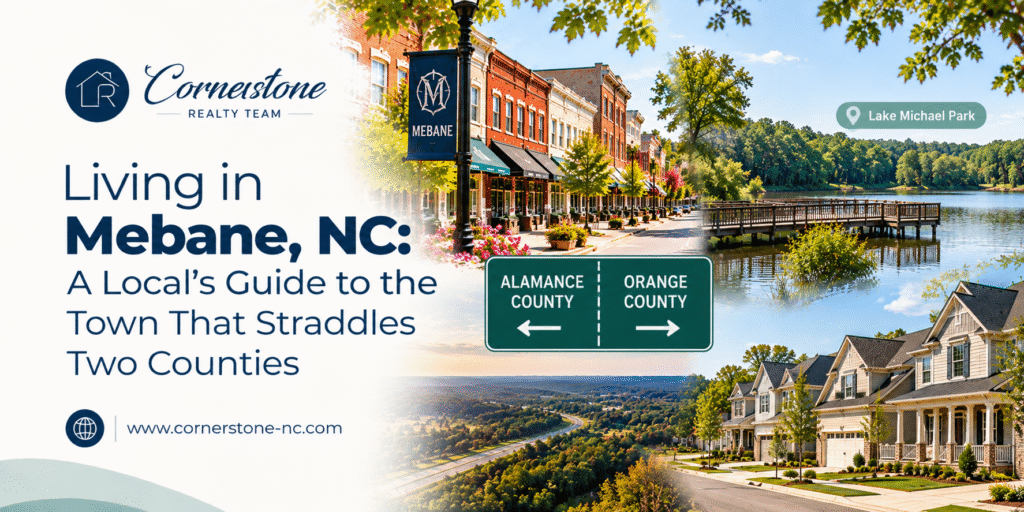
If you’ve driven I-40/85 between Durham and Greensboro, you’ve passed Mebane. For a long time that’s all most people did. Not anymore. Mebane has become one of the fastest-growing cities in North Carolina, and buyers who used to look only at Durham, Chapel Hill, or Hillsborough are now asking us about it regularly. First, the question everyone asks: locals say it “MEB-in.” Second, the thing almost nobody knows until they’re under contract: Mebane sits in two counties. Most of the city is in Alamance County, but the eastern edge crosses into Orange County. Two homes a few miles apart, both with a Mebane address, can have different property tax bills and different school systems. We’ll walk through exactly what that means below. Why Mebane Is Growing So Fast Mebane’s location is the whole story. It sits right on the I-40/85 corridor, which puts you within reasonable driving distance of Durham, Chapel Hill, Burlington, and Greensboro. For households where one person works in the Triangle and another works in the Triad, it’s one of the few places that genuinely works for both commutes. The growth numbers back that up. Mebane added roughly 1,700 residents between 2023 and 2025, per Census estimates, and remains one of the fastest-growing municipalities in the state. The city has been deliberate about pacing that growth, focusing on infrastructure like wastewater capacity and roads before approving more homes. Jobs are following the people. Mebane has three large economic development zones, including the roughly 1,200-acre North Carolina Commerce Park off Trollingwood-Hawfields Road, which is also where a Buc-ee’s travel center is coming. The city is building a fourth fire station near that interchange to keep pace. Distribution, logistics, and manufacturing employers along the interstate have made Mebane a place people work, not just a place people sleep. Why We’re Bullish on the Mebane–Burlington–Graham Corridor Here’s our honest take after years of selling in this area: we think the Mebane, Burlington, and Graham corridor is one of the better long-term bets in central North Carolina for growth and appreciation. The reason is simple. This corridor is commutable to both the Triangle and the Triad, so growth is coming from both directions. Most growing suburbs have one engine. They rise and fall with a single metro’s job market. Mebane, Burlington, and Graham sit between two. From the east, buyers priced out of Durham, Chapel Hill, and Hillsborough keep pushing west along I-40/85 looking for value. From the west, the Triad is landing major employers of its own, like Toyota’s battery manufacturing campus in Liberty and Boom Supersonic’s aircraft factory at Piedmont Triad International Airport. Those jobs pull workers toward Greensboro, and the eastern side of that commute shed runs right through Alamance County. When demand is building from two sides at once, the towns in the middle tend to feel it. That’s what we’re seeing in the population numbers, in the new construction, and in the commercial investment along the interstate. To be clear, nobody can promise what any specific home will be worth in five or ten years, and markets move in cycles. Buy a home you’ll be happy living in, at a price that works for your budget today. But if you’re weighing where your money might grow over the long run, this corridor’s position between two expanding job markets is a big part of why we like it. The County Line: What It Means for You This is the part of the post worth bookmarking. Property taxes In North Carolina, your property tax bill is the county rate plus your city rate (plus any fire or special district, if applicable). Mebane’s city rate is the same on both sides of the county line. The county rate is not. For fiscal year 2026-27: Alamance side of Mebane Orange side of Mebane County rate (per $100) $0.494 $0.6805 Mebane city rate (per $100) $0.37 $0.37 Combined rate $0.864 $1.0505 Est. annual tax on a $400,000 assessed value ~$3,456 ~$4,202 That’s roughly a $750-a-year difference on the same assessed value, and it compounds over the years you own the home. Orange County raised its rate by about 4 cents this year; Alamance held its rate flat. Mebane’s city council also kept its rate at 37 cents after a proposed increase. One caveat: your tax bill is based on the county’s assessed value, not your purchase price. Alamance and Orange revalue on different schedules, so assessed values can lag or lead the market differently in each county. Always look up the specific parcel’s assessed value before you compare. Schools This is the other big one. Addresses on the Alamance side of Mebane are served by the Alamance-Burlington School System (ABSS). Mebane-area ABSS schools include E.M. Yoder, South Mebane, and Audrey W. Garrett elementary schools, Hawfields and Woodlawn middle schools, and Eastern Alamance High School. Addresses on the Orange side are served by Orange County Schools, the district based in Hillsborough. This is a different district from Chapel Hill-Carrboro City Schools, which is a common point of confusion. We cover the local districts in more detail in our school zones guide. There’s also a newer charter option: Carolina Achieve, a public charter that opened in 2025 on West Ten Road, on the Orange County side of Mebane, starting with the early grades and adding a grade each year. Our rule for every Mebane buyer with kids: verify the school assignment for the exact address with the district before you write an offer. Don’t rely on the listing, a neighbor, or a website (including this one). Boundaries shift as the city grows. Which side is right for you? There’s no universally better side. It depends on what you’re optimizing for. Buyers focused purely on monthly cost often find more value on the Alamance side. Buyers who specifically want Orange County Schools, or who want to be a few minutes closer to Hillsborough and Durham, often lean Orange side. The key is knowing which one you’re looking at before you fall in
Living in Hillsborough, NC: A Local’s Guide to Orange County’s Historic Heart
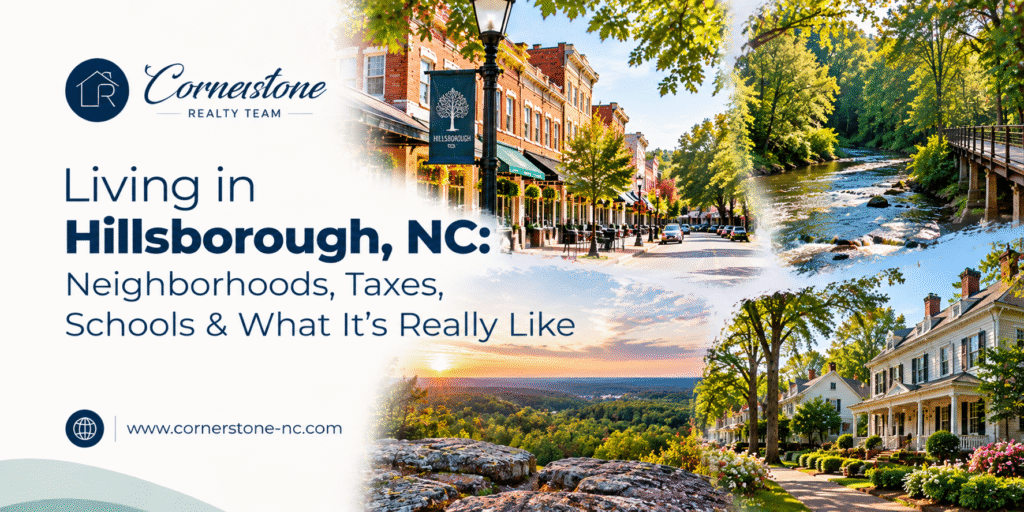
Hillsborough has a way of winning people over. Buyers come to look at one house, walk down Churton Street afterward, and start asking what else is available in town. It’s easy to see why. Hillsborough is the Orange County seat, a town founded in the 1750s with a genuinely historic downtown. It’s about 20 minutes from both Durham and Chapel Hill, and it’s growing without losing what makes it feel like Hillsborough. It also tends to be overshadowed by its bigger neighbors in online searches, which means a lot of buyers don’t discover it until they’re already deep into their search. Here’s what you should know. What It’s Like to Live Here Downtown is the heart of it all. Churton Street and the blocks around it are lined with historic buildings, locally owned restaurants, coffee shops, and galleries. The town’s Last Fridays art walk brings people downtown every month. Weaver Street Market, a local co-op grocery, is a community hub, and Eno River Brewing and Hillsborough BBQ Company are local favorites. The outdoors are right in town. The Riverwalk is a paved greenway along the Eno River that connects neighborhoods to downtown. It’s one of the most-loved features of living here. Gold Park sits along it, and Occoneechee Mountain State Natural Area, just outside downtown, has hiking trails and one of the best views in Orange County. Ayr Mount, a historic 1815 plantation house with its own walking trail, is just east of town. It’s a real small town. You’ll run into people you know at the grocery store. There’s a strong sense of community, and many residents are active in local government, historic preservation, and the arts. Hillsborough’s Neighborhoods Hillsborough’s housing ranges from 18th- and 19th-century homes to brand-new construction, with plenty in between. Historic District. The streets surrounding downtown hold some of the oldest homes in the Triangle, with a mix of restored historic homes, cottages, and a few newer infill builds. If walking to dinner matters to you, this is where to look. Keep in mind that homes in the historic district come with preservation guidelines on exterior changes, which is worth understanding before you plan a renovation. West Hillsborough. The historic mill village area west of downtown has smaller, older homes with a lot of character and some of the more accessible price points in town. It’s popular with buyers who want to be near downtown without the historic-district price tag. Waterstone. A newer mixed-use area on the south side of town, near UNC Health’s Hillsborough campus and Durham Tech’s Orange County campus, with quick access to I-40. Cates Creek Park is here. Collins Ridge. A large master-planned community just south of downtown, about a half-mile from the historic core and close to both I-40 and I-85. It’s been one of the most active sources of new construction in town, with single-family homes and townhomes, plus a pool, clubhouse, pickleball courts, and trails. Rural Hillsborough. Head north or west toward Efland and Cedar Grove and you’ll find acreage, farmland, and homes with real privacy. Many of these properties have a Hillsborough mailing address but sit outside town limits, which affects taxes, utilities (often well and septic), and services. More on that below. Worth knowing: A “Hillsborough” address doesn’t always mean you’re inside the Town of Hillsborough. Many homes are in unincorporated Orange County. That’s not a bad thing (often it means lower taxes and more land), but it changes your tax bill, your utilities, and which services you receive. Always check the parcel. Property Taxes Hillsborough sits in Orange County, which has some of the higher property tax rates in the region. For fiscal year 2026-27: Rate per $100 of assessed value Orange County $0.6805 Town of Hillsborough $0.5130 Combined (inside town limits) $1.1935 On a home assessed at $400,000, that’s roughly $4,774 a year. Orange County raised its rate by about 4 cents this year. For comparison, that’s lower than Chapel Hill or Carrboro, where an additional school district tax pushes combined rates above $1.30. It’s higher than the Alamance side of Mebane, where the combined rate is about $0.86. If you’re outside town limits, you’ll pay the county rate plus a fire district tax instead of the town rate, which usually comes in lower. Schools Hillsborough is served by Orange County Schools, which is a separate district from Chapel Hill-Carrboro City Schools. This is one of the most common points of confusion we see with relocating buyers, especially those who’ve read about Chapel Hill schools and assume all of Orange County is in that district. School assignments within Orange County Schools depend on your specific address, so verify with the district before you buy. Our school zones guide breaks down how the local districts work. Commute Times (Approximate, Off-Peak) Destination Approx. drive Duke / Downtown Durham 20 min UNC Chapel Hill 20 min Mebane 15 min RTP 30 min RDU Airport 30 min Raleigh 40 min Hillsborough’s location right at the I-40/I-85 split is a big part of its appeal. You can head toward Durham, Chapel Hill, or west toward Mebane and Burlington easily. What’s Coming A train station. Hillsborough is planning a passenger rail station, currently targeted for around fiscal year 2028. A new greenway, the Ridgewalk, is planned to connect downtown to the station and eventually to Collins Ridge and Cates Creek Park. It’s a longer-term project, but it could be meaningful for commuters and for the town’s walkability. Continued growth, carefully managed. New construction in Collins Ridge and elsewhere continues, but Hillsborough takes historic preservation and planning seriously. The downtown character isn’t going anywhere. Is Hillsborough Right for You? Hillsborough tends to be a great fit if you: Want a walkable, historic small town that’s still close to Durham and Chapel Hill Work at Duke, UNC, or UNC Health Want options ranging from historic homes to new construction to acreage Care about community, local businesses, and outdoor access It may be less ideal if you need Chapel
Living in Burlington, Graham & Elon, NC: A Guide to Alamance County’s Core
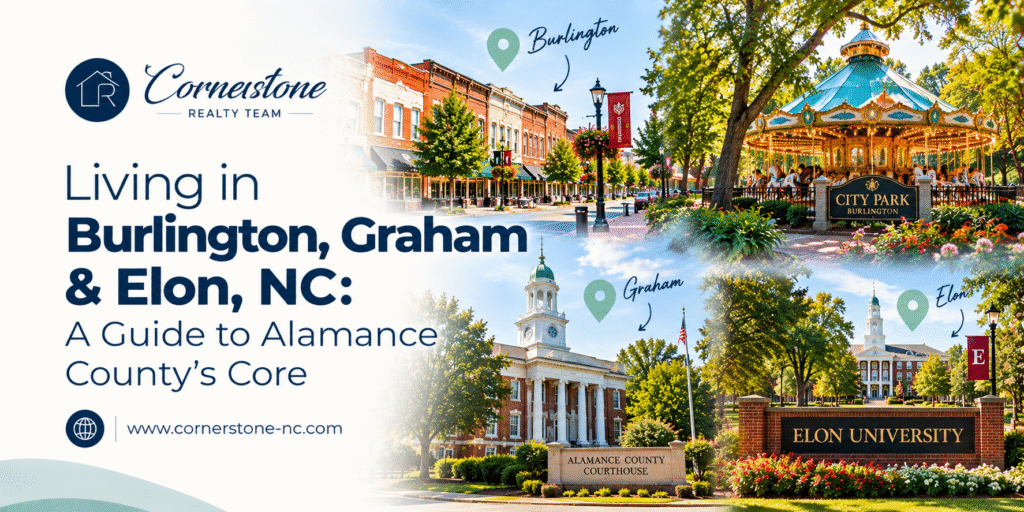
Ask most Triangle buyers about Alamance County, and they’ll mention Mebane, if they mention anything at all. But just a few exits west on I-40/85, three connected towns make up the heart of the county: Burlington, Graham, and Elon. Each has its own personality. Burlington is the county’s largest city, with established neighborhoods and the most affordable price points. Graham is the historic county seat and the fastest-growing town in Alamance. Elon is a university town with a walkable, tree-lined center. Together they offer something that’s getting harder to find near the Triangle: real value, real character, and room to grow. Here’s what you should know about each one. Why This Area Is on Our Radar The short answer: location and value. Burlington, Graham, and Elon sit on the I-40/85 corridor between the Triangle and the Triad. Durham and Chapel Hill are roughly 35 to 45 minutes east. Greensboro is about 20 to 30 minutes west. For households with jobs in both directions, or with hybrid schedules, that’s a rare combination. And the value is real. Through August 2026, the median sale price in Alamance County was $325,000, about $235,000 below the median in neighboring Orange County. (For a deeper look at that gap, see our post, Priced Out of Durham or Chapel Hill.) Why We’re Bullish on This Corridor Our team sees the Mebane, Burlington, and Graham corridor as one of the better long-term bets in central North Carolina for growth and appreciation, and the reason is simple: it’s commutable to both the Triangle and the Triad, so growth is coming from both sides. From the east, buyers priced out of Durham and Chapel Hill keep moving west looking for value. From the west, the Triad is adding major employers like Toyota’s battery manufacturing campus in Liberty and Boom Supersonic’s aircraft factory at Piedmont Triad International Airport. Those jobs pull workers toward Greensboro, and the eastern side of that commute runs right through Alamance County. The population numbers reflect it. Alamance County added about 7,000 residents between 2023 and 2025, and Graham grew faster than any other town in the county, adding nearly 10% to its population in just two years. No one can guarantee what any home will be worth down the road, and markets move in cycles. But towns sitting between two growing job markets tend to benefit from both, and that’s a big part of why we’re spending so much time here. We cover this in more depth in our Mebane guide. Burlington The big picture: With around 61,000 residents, Burlington is Alamance County’s largest city and its commercial center. It grew up as a textile town (Burlington Industries took its name from the city), and today it’s home to LabCorp’s headquarters and Alamance Regional Medical Center. What it’s like to live here: Burlington has a classic downtown anchored by the historic Paramount Theater, plus local restaurants and shops. City Park is a local treasure, home to a restored, historic Dentzel carousel that generations of Alamance kids have ridden. In summer, the Burlington Sock Puppets play minor league baseball at Burlington Athletic Stadium, and the Haw River Trail offers paddling and hiking along the river. Everyday shopping and dining are easy, with plenty of options along the interstate. Housing: Burlington offers the widest range of housing in the area and some of the most accessible price points anywhere near the Triangle. You’ll find historic homes in the older neighborhoods near downtown, mid-century ranches and established subdivisions throughout the city, and newer construction on the edges. Mackintosh on the Lake, a master-planned community near Lake Mackintosh on the south side of the county, is a popular option for buyers who want amenities and newer homes. Best fit for: Buyers who want the most house for their money, more inventory to choose from, and easy access to Greensboro. Graham The big picture: Graham is the Alamance County seat, sitting right next to Burlington, and it’s the fastest-growing town in the county. Its location close to the I-40/85 interchanges makes it especially convenient for commuters heading east. What it’s like to live here: Graham’s downtown is built around its historic courthouse square, with local restaurants, shops, and the Graham Cinema, a beloved single-screen movie theater that’s been a fixture downtown for decades. It has a genuine small-town feel while sitting right next to everything Burlington offers. Alamance Community College’s main campus is also in Graham. Housing: Graham’s growth has brought a steady stream of new construction, both single-family homes and townhomes, alongside established neighborhoods and older homes near downtown. For buyers who want something newer at a price well below the Triangle, Graham is worth a close look. Best fit for: Buyers who want new construction, a small-town downtown, and a slightly shorter drive toward Durham and Chapel Hill than Burlington or Elon. Elon The big picture: Elon is a small town on the west side of Burlington, and it’s best known as the home of Elon University. The campus is widely considered one of the most beautiful in the South, and the university shapes much of the town’s character. What it’s like to live here: Elon’s downtown sits right alongside campus, with coffee shops, restaurants, and a walkable, college-town energy. Residents enjoy access to university events, from concerts and lectures to athletics. It’s quieter than a big-college town, with a polished, tree-lined feel. Housing: Elon’s housing stock includes established neighborhoods close to campus, newer subdivisions on the edges of town, and homes that attract university faculty and staff. Prices tend to run a bit higher than Burlington, reflecting the demand around the university. Homes near campus can also appeal to investors, since there’s steady rental demand from students and university employees. Best fit for: Buyers who want a walkable, college-town atmosphere, university faculty and staff, and anyone commuting toward Greensboro. Property Taxes All three towns are in Alamance County, which has one of the lower county tax rates in the region: $0.494 per $100 of assessed value
South Durham & Southpoint: Shopping, Schools, and Suburban Living Near RTP
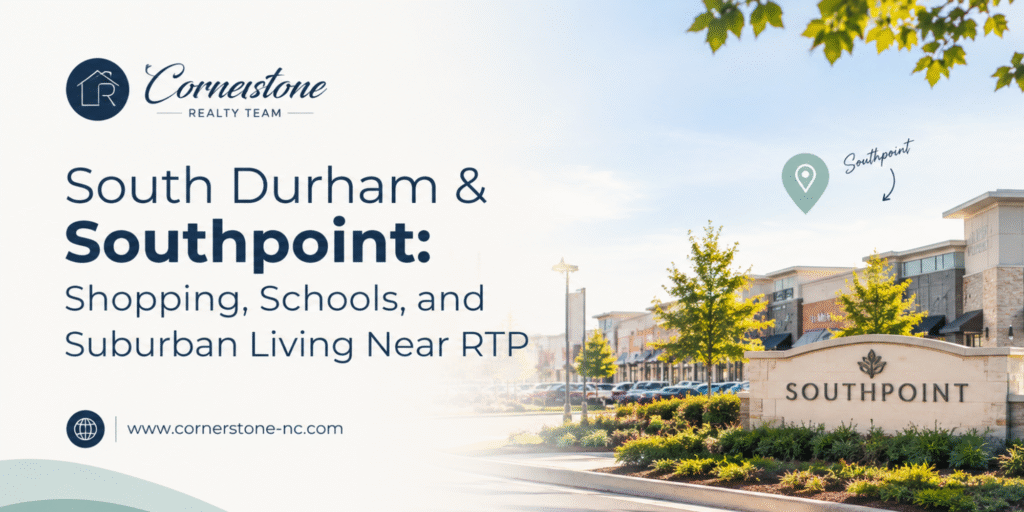
If Trinity Park and Duke Park represent Durham’s historic, walkable core, South Durham — anchored by the Southpoint area — is the city’s suburban counterweight. It’s where a lot of RTP employees, young families, and move-up buyers end up once they’ve compared commute times, school options, and square footage against the price of an in-town bungalow. Here’s what you need to know if South Durham is on your list. Where “South Durham” Actually Is South Durham isn’t a single subdivision — it’s a broad area south of I-40, roughly bounded by NC-751 and Fayetteville Street, that includes established communities like Woodcroft, Hope Valley, Parkwood, and the newer developments clustered around The Streets at Southpoint mall. When buyers say they want to be “near Southpoint,” they usually mean this general corridor rather than one specific neighborhood, which is part of why it’s worth understanding the sub-areas separately before you start touring. Woodcroft is one of the more established communities in the area, popular with buyers who want mature landscaping, a mix of housing styles, and easy access to the American Tobacco Trail. Hope Valley sits closer to the historic Hope Valley Country Club and tends to run toward larger, higher-end homes on wooded lots. Parkwood is generally more affordable and appeals to first-time buyers who still want the South Durham location without the premium. Newer master-planned communities near the mall itself — places like Jordan at Southpoint and The Hills at Southpoint — offer contemporary construction and HOA-maintained amenities, at a price point that reflects the newer build. What Draws Buyers to This Area The commute. South Durham sits within about 15 minutes of RTP, Duke, downtown Durham, and downtown Chapel Hill, and it’s roughly 20 minutes from RDU. For a dual-career household where one person works in RTP and the other commutes toward Chapel Hill or downtown Durham, this location often makes more sense on a map than either downtown option alone. The shopping and dining. The Streets at Southpoint is one of the largest retail and dining hubs in the Triangle, and its presence has pulled in a steady stream of restaurants, grocery options, and services nearby — which matters more than it sounds like for day-to-day convenience once you’re not living downtown. The housing mix. Unlike the historic core, where inventory skews toward smaller lots and older construction, South Durham offers a genuine range — condos and townhomes in the low $300,000s up through executive single-family homes well north of $900,000 in communities like The Hills at Southpoint. That range means the area works for first-time buyers and move-up buyers alike, which isn’t true of every Durham submarket. Green space. The American Tobacco Trail runs through the area and connects to Piney Wood Park, giving residents walkable and bikeable access to green space that’s harder to come by inside the beltline. Schools South Durham is zoned for Durham Public Schools, and like most of Durham, families here have both their base-assigned school and access to DPS’s magnet and year-round programs through the district’s lottery process. Because zone lines can split streets within the same subdivision, don’t assume a school assignment based on the neighborhood name alone — always confirm the specific address using DPS’s official school locator before writing an offer, especially if a particular school is a deciding factor. Who South Durham Is Right For This area tends to be the right call for buyers who want: A shorter commute to RTP or Duke than most in-town Durham neighborhoods offer More house and lot for the money than comparable inside-the-beltline options Easy access to shopping, dining, and the American Tobacco Trail A range of price points within the same general location, from townhomes to executive homes It’s a less obvious fit for buyers who specifically want historic architecture, walkable urban density, or a short walk to downtown Durham’s restaurant scene — that’s Trinity Park and Duke Park territory, not Southpoint. Buying in South Durham? Start With a Plan. The range of inventory in South Durham — from $300,000 townhomes to $1M+ golf-adjacent estates — means “South Durham” can mean very different budgets and very different neighborhoods depending on what you’re comparing. Before you tour, it’s worth getting clear on financing, timeline, and what trade-offs matter most to you. Download the Triangle Buyer Playbook — a step-by-step guide to buying in the Triangle market, covering financing, offer strategy, and what to expect at each stage, built specifically for Durham and Orange County buyers
Understanding School Zones in Durham & Orange County: A Guide for Home Buyers

For a lot of buyers, “what school is this zoned for?” isn’t a secondary question — it’s the question that decides which neighborhoods make the list at all. Durham and Orange County run different school systems with different rules, so it’s worth understanding how each one actually works before you fall in love with a house. Durham vs. Orange County: You’re Choosing Between Different Districts This trips people up more often than you’d expect. Depending on where you buy, you’ll land in one of three different public school systems: Durham Public Schools (DPS) — serves Durham County Chapel Hill-Carrboro City Schools (CHCCS) — serves the towns of Chapel Hill and Carrboro Orange County Schools (OCS) — serves the rest of Orange County outside Chapel Hill These are three separate districts with their own boundaries, calendars, and enrollment processes. A home just a few miles apart in Orange County can be zoned for CHCCS or OCS depending on which side of the town line it falls on — and the two districts are not interchangeable in terms of programs, ratings, or reputation, so don’t assume “Orange County” tells you which one you’re getting. How Base Assignment Actually Works In all three districts, your child’s default (“base”) school is determined by your home address, not by which neighborhood or subdivision you’re in. Subdivision names and marketing materials are not a reliable source for this — zone lines frequently split neighborhoods, and even split individual streets. Always verify the specific address. Durham Public Schools (DPS) — serves Durham County Chapel Hill-Carrboro City Schools (CHCCS) — serves the towns of Chapel Hill and Carrboro Orange County Schools (OCS) — serves the rest of Orange County outside Chapel Hill Magnet, Lottery, and Choice Options Base assignment isn’t the end of the story, particularly in Durham. DPS operates a significant number of magnet and year-round schools that families can apply to through a lottery process, separate from their base-assigned school. This means two things worth knowing as a buyer: 1. A home’s base assignment doesn’t necessarily reflect every option available to a family at that address — magnet and lottery seats can open up other schools entirely. Lottery admission isn’t guaranteed, so if a magnet or year-round program is central to your decision, don’t buy on the assumption that a seat will be available — check current lottery odds and timelines with the district directly. CHCCS and OCS have more limited school-of-choice options compared to DPS, so base assignment tends to carry more weight as a deciding factor for families choosing between Chapel Hill/Carrboro and other parts of Orange County. How to Actually Check a School Zone Before writing an offer on a home where schools matter to your decision: 1 .Confirm the exact address (not just the neighborhood name) against the relevant district’s official boundary map or locator tool. 2. Check whether the property sits within city limits for Chapel Hill/Carrboro versus the surrounding parts of Orange County — this determines CHCCS vs. OCS. 3. If a magnet, year-round, or specialty program matters to you, confirm current application windows and lottery odds directly with the district rather than relying on secondhand information. 4. Ask your agent to pull the specific base assignment for any home you’re seriously considering — this is a five-minute check that can save you from a costly assumption. Download the Ultimate Guide to Buying a Home — it walks through how to evaluate a home against the factors that matter most to your family, schools included, before you’re under contract and racing the clock. Why This Is Worth Doing Early School zone lines shift periodically as districts redraw boundaries to manage enrollment, so even reliable secondhand information (a neighbor’s assignment, a listing description, an older map you found online) can be out of date. Verifying directly with the district — and doing it before you tour, not after you’ve made an offer — is the only way to be confident you’re not buying based on an assumption that turns out to be wrong. If schools are a top priority in your search, let’s talk through your must-haves early so we can filter neighborhoods by verified, current assignment data rather than working backward from a home you already love
Cost of Living in Durham & Orange County vs. the Major Metros You’re Leaving Behind

If you’re relocating to the Triangle for a job in tech, biotech, or academia, you’ve probably already run a mental cost-of-living comparison against wherever you’re coming from. Here’s what the actual numbers look like — and why the gap is often bigger than people expect going in. The Headline Numbers Based on 2026 cost-of-living index data, Durham runs meaningfully lower than the major metros that send the Triangle the most relocators: Moving from Durham’s cost of living is roughly San Francisco Bay Area 75% lower New York City 62% lower Boston 42% lower Washington, D.C. 33% lower These are index-based comparisons that roll up housing, groceries, transportation, healthcare, and everyday goods and services — not just home prices. Housing is usually the single biggest driver of the gap, but it’s rarely the only one; utilities, dining out, and even childcare tend to run lower here too. Why This Matters More Than a Single Number Suggests A lower cost-of-living index doesn’t automatically mean your paycheck goes further, because salaries adjust too — a role that pays well in San Francisco often pays less in Durham for the equivalent position. What tends to change the math in relocators’ favor is: Remote or hybrid roles that keep a coastal salary. If your compensation isn’t tied to the local Triangle market, the cost-of-living gap becomes pure upside — the same paycheck simply covers more here. Housing, specifically. Even accounting for lower local salaries, the price-per-square-foot difference between the Triangle and markets like the Bay Area or Boston is large enough that many relocators can move from renting to owning, or from a starter home to significantly more space, without increasing their monthly housing cost. No state income tax shock, but do check the total picture. North Carolina has a flat state income tax, which is a different structure than what many relocators are used to (particularly those coming from states with no income tax, like Texas or Florida, where the comparison runs the other way). It’s worth running your specific numbers rather than assuming. What This Means for Your Budget If you’re relocating with a job offer already in hand, the practical exercise isn’t “is Durham cheaper” — it almost certainly is compared to the coastal metros above — it’s translating that gap into an actual home-buying budget. A rough starting framework: 1 .Take your current monthly housing cost (rent or mortgage) in your current city. 2. Compare it to typical monthly costs for Durham and Orange County homes in your target neighborhoods — these vary significantly between, say, South Durham and Chapel Hill, so pull specific comparables rather than relying on citywide averages. 3. Factor in North Carolina property tax rates, which differ by county and will affect your monthly payment more than they likely did in your previous location. Download the Ultimate Guide to Buying a Home — it covers how to turn a relocation budget into a realistic offer strategy in the Durham and Orange County market, including financing steps that are easy to miss when you’re buying long-distance. A Note on Data Sources Cost-of-living comparisons vary somewhat depending on the index provider and the specific neighborhoods being compared, so treat these figures as directional rather than exact. If you’re actively comparing a specific city or neighborhood, we’re happy to pull more granular numbers for your situation, including current property tax rates by county and typical carrying costs for the type of home you’re looking for. Where to Land in Durham or Orange County The cost-of-living advantage holds across the region, but where you land still matters. Chapel Hill and Carrboro run at a premium relative to Durham, driven largely by school district demand and proximity to UNC. South Durham and neighborhoods like Southpoint tend to offer the most house for the money for buyers prioritizing commute and space. If a specific employer or commute is driving your relocation, that’s usually the best starting point for narrowing down which side of the region makes sense.
Brier Creek: The Durham-Raleigh Border Option for RTP Commuters
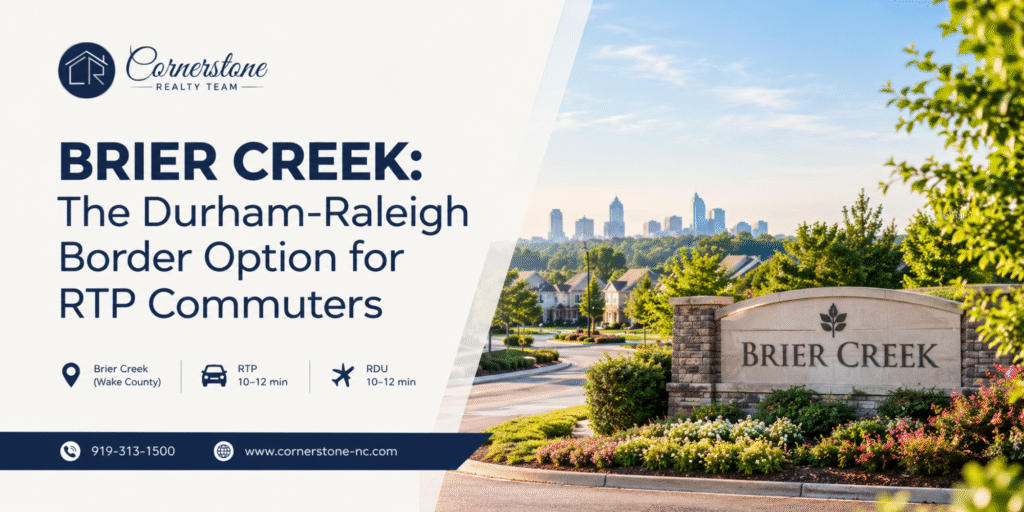
A lot of buyers relocating for a Research Triangle Park job ask the same question early on: “Should I live on the Durham side or the Raleigh side?” Brier Creek comes up constantly in that conversation, so it’s worth a clear-eyed look — including the fact that it sits in Wake County, not Durham County, which matters for taxes and schools even though the commute story is nearly identical. Where Brier Creek Sits Brier Creek is a master-planned community in northwest Raleigh, just off I-540 near US-70, in the 27617 zip code. It’s not literally inside Durham’s city limits, but it’s genuinely convenient to both Durham and Raleigh — close enough to RTP, RDU, and downtown Durham that plenty of people who work in Durham or RTP choose to live here for the newer construction, amenities, and highway access, while accepting the Wake County side of the ledger for taxes and schools. Why It Comes Up in Durham/RTP Relocation Searches RTP commute. Brier Creek sits roughly 10–12 minutes from RTP and about the same distance from RDU, making it genuinely comparable to South Durham for anyone whose job is inside the Park rather than downtown Durham specifically. Housing stock. Brier Creek is a newer, master-planned area with a wide range of product types — condos and entry-level townhomes in the low-to-mid $400,000s, up through executive single-family homes on golf-course lots well over $1M. That range makes it a common comparison point for buyers cross-shopping South Durham or Southpoint. Amenities. The neighborhood is built around Brier Creek Commons and The Streets at Brier Creek, a large shopping and dining corridor, plus a golf and country club, greenways, and proximity to William B. Umstead State Park for hiking and trails. The County Line Actually Matters Here This is the part that trips up relocators who are cross-shopping Durham and Wake counties without realizing Brier Creek sits fully in Wake: Schools: Brier Creek is zoned for Wake County Public School System (WCPSS), not Durham Public Schools — a different district with its own assignment map, calendar, and magnet/lottery process. If a specific Durham school was part of your decision, Brier Creek won’t deliver it. Property taxes: You’ll pay Wake County and City of Raleigh tax rates here, not Durham County or City of Durham rates — worth running the numbers side by side rather than assuming they’re similar. Everyday services: Trash pickup, water/sewer, and permitting run through Raleigh and Wake County, not Durham — a small thing day to day, but a real difference from living a few miles away in South Durham. Durham or Wake County? What to Compare Before You Decide If you’re choosing between Brier Creek and a Durham County option like South Durham for the same RTP job, the honest answer is that commute times are close enough that they shouldn’t be the deciding factor on their own. Property tax rates, school district fit, and the type of home you can get for your budget usually matter more — and those numbers are worth comparing directly rather than assuming. Download the Triangle Buyer Playbook — it walks through how to compare towns and counties across the Triangle on the factors that actually affect your monthly payment and daily life, not just commute time. Who Brier Creek Is Right For Brier Creek tends to make the most sense for buyers who: Work in RTP or at RDU and want newer construction with strong amenities Are comparing Wake County schools and tax rates against Durham or Orange County and prefer the Wake County side Want walkable shopping and dining without living inside a city core If staying in Durham County specifically — for schools, taxes, or simply wanting a Durham address — is a hard requirement, South Durham and Southpoint deliver a similar commute profile without leaving the county. Not sure which side of the line is the better fit for your situation? That’s exactly the kind of comparison worth talking through before you start touring — reach out and we can map it against your specific job location, budget, and school priorities.
Trinity Park & Duke Park: Durham’s Historic Neighborhoods Explained
If you’ve spent any time driving through central Durham, you’ve probably admired the wide front porches, mature oak trees, and mix of Craftsman bungalows and Colonial Revivals that define the city’s oldest neighborhoods. Two of the most sought-after are Trinity Park and Duke Park — both historic, both walkable, both packed with character, but each with a distinct personality and price point. If you’re weighing which one fits your lifestyle (or budget), here’s a local’s breakdown of both. Trinity Park: Durham’s Most Iconic Historic District Trinity Park sits between downtown Durham and Duke University’s East Campus, and it’s exactly what people picture when they imagine “historic Durham.” The neighborhood developed in the early 1900s alongside Trinity College — the school that would later become Duke University — and much of it is now protected as a National Register Historic District, spanning roughly 280 acres and hundreds of documented historic structures. Architecture & character Expect a genuine mix of Queen Anne, Colonial Revival, Victorian, and Craftsman-style homes, many dating to the 1900s–1930s. Tree-lined streets, deep front porches, and detailed millwork are the norm rather than the exception. The Trinity Park Neighborhood Association has been active for decades preserving that character, so you won’t find teardown-and-rebuild pressure here the way you might in newer suburbs. Price range Homes in Trinity Park typically run from the $300,000s for smaller or fixer-upper properties up to well over $1,000,000 for fully restored or larger historic homes. It’s consistently one of the higher-priced neighborhoods in Durham proper, and homes here tend to sell quickly when priced appropriately. Walkability & amenities This is one of the most walkable neighborhoods in Durham. Ninth Street’s shops and restaurants, Duke’s East Campus, and Downtown Durham (including Brightleaf Square and the American Tobacco District) are all within easy walking or biking distance. Durham School of the Arts, a magnet school housed in a beautiful 1920s-era building, also sits inside the district. Who it’s right for Buyers who want walkability above almost everything else, appreciate architectural detail (and are prepared for the maintenance that comes with it), and want to be close to Duke and downtown nightlife. It’s also a strong fit for buyers who value historic-district protections and a tight-knit neighborhood association. Duke Park: Historic Charm, More Breathing Room About a mile north of Trinity Park, Duke Park offers a different flavor of historic living — same era, more space, and generally more affordable entry points. The neighborhood grew up around the 17-acre Duke Park itself in the 1920s and ’30s, on land that was once part of the Brodie Duke family estate. Architecture & character Duke Park’s housing stock is a blend of Craftsman bungalows, Cape Cods, Victorians, and mid-century ranches, sitting on lots that run larger than what you’ll typically find in Trinity Park — often a tenth of an acre up to half an acre, with generous front yards. It has a quieter, more neighborhood-y feel, anchored by the park itself, which hosts concerts, movie nights, and community events throughout the year. Price range Most homes in Duke Park fall between roughly $375,000 and $685,000, with fully renovated historic homes or larger new builds occasionally reaching $900,000 to $1,000,000. That makes it a meaningfully more accessible entry point into Durham’s historic core compared to Trinity Park, without giving up the tree-lined, walkable character. Walkability & amenities Duke Park is a little more car-dependent than Trinity Park — sidewalks are present but inconsistent, and downtown is a bit far to comfortably walk. That said, it’s a genuinely bike-friendly neighborhood, with dedicated bike lanes on Washington Street and the Ellerbee Creek Trail running along its western edge. I-85 access is quick, and RTP is roughly a 10-15 minute drive. Who it’s right for Buyers who want historic character and a strong sense of community but need more square footage or yard space for the money. It’s also a great fit for families — the neighborhood consistently draws buyers who want a central Durham location without in-town pricing, and it’s zoned for well-regarded Durham Public Schools. Trinity Park vs. Duke Park: Quick Comparison Trinity Park Duke Park Era built 1900s–1930s 1920s–1930s Typical price range $300K – $1M+ $375K – $685K (up to ~$1M for premium renovations) Walkability Excellent — steps from Ninth Street & Duke Good for biking, moderate for walking Lot size Smaller, in-town lots Larger, more yard space Best for Walkability-first buyers, architecture lovers Families, buyers wanting more space at a lower price point The Bottom Line Both neighborhoods deliver something you genuinely can’t buy in most newer Durham subdivisions: a real sense of place, mature trees, and architecture with a story behind it. Trinity Park wins on walkability and prestige; Duke Park wins on value and space. The right choice really comes down to how you want to live day-to-day — and what you’re comfortable maintaining in a home that’s often 90-100 years old. Buying a historic home comes with its own learning curve — older wiring, renovation restrictions in a designated district, competitive offers on well-priced listings. That’s exactly the kind of thing that trips up buyers who don’t see it coming. Avoid the Mistakes That Cost Triangle Buyers Thousands Get our free Triangle Buyer Playbook — a straightforward guide to navigating older homes, competitive offers, and the buying process from start to finish, so you walk into Trinity Park or Duke Park with confidence, not surprises. Get the Free Buyer Playbook
Relocating for RTP: A Guide for Tech Employees

If you just accepted an offer from a company in Research Triangle Park, welcome — you’re joining a region that’s been quietly becoming one of the country’s most active tech hubs. RTP is home to more than 300 companies, from long-time anchors like IBM, Cisco, and SAS to newer major investments from Apple, Google, and Novartis. If you’re relocating for a job here, this guide covers the practical stuff: your realistic timeline, what things actually cost, and where to consider living based on your commute and lifestyle. Why So Many Tech Employees Are Landing Here RTP isn’t a single office park anymore — it’s shorthand for a tech ecosystem that stretches across Durham, Wake, and parts of Orange and Chatham counties. Recent years have brought major expansions and new campuses from companies across software, biotech, and semiconductors, on top of the legacy employers that have anchored the area since the 1960s. For relocating employees, the practical upside is real: salaries in Triangle tech roles are often comparable to what you’d earn in higher-cost markets, but North Carolina’s flat income tax and meaningfully lower housing costs mean your money goes further here than in places like the Bay Area, Seattle, or DC. A Realistic Relocation Timeline Most out-of-state buyers underestimate how much runway they need. Here’s a more realistic breakdown: 8-12 weeks out: Get pre-approved with a lender (ideally one familiar with out-of-state/relocation buyers), and start getting oriented on neighborhoods — this is the point to talk to a local agent, even if you’re not ready to look at listings yet. 6-8 weeks out: Start actively touring homes, virtually or in person. If you can plan a single trip to see multiple neighborhoods in a few days, that’s usually more efficient than several shorter trips. 4-6 weeks out: Submit offers, move through inspection and closing. The Triangle’s average time from accepted offer to closing typically runs 30-45 days, depending on financing. 2-4 weeks out: Coordinate movers, utility transfers, and school enrollment if you have kids — Durham Public Schools and Orange County/Chapel Hill-Carrboro City Schools both have enrollment windows worth planning around. Moving week: Give yourself buffer. Even a well-planned move has surprises, and you don’t want your first week at a new job to also be your first week unpacking boxes. If your start date is tighter than this timeline allows, renting short-term while you search is a completely normal move — better to take your time finding the right neighborhood than rush into a purchase in an unfamiliar area. Where to Live: Matching Neighborhoods to Your Commute Where you land in Durham or Orange County should depend heavily on which part of RTP (or which specific employer) you’re commuting to. If you’re commuting daily to RTP itself: South Durham neighborhoods near Southpoint, or areas around Woodcroft and the 54/55 corridor, offer some of the shortest commutes — often 10-15 minutes to RTP’s core campuses. If you want walkability and city life over commute time: Downtown Durham, Trinity Park, or Duke Park put you close to restaurants, breweries, and Duke University, with a slightly longer but still manageable RTP commute (15-25 minutes depending on traffic). If you’re drawn to a college-town feel: Chapel Hill and Carrboro offer a different pace — walkable downtowns, strong schools, and proximity to UNC — with a commute to RTP that runs longer, typically 25-35 minutes, but many find it worth the tradeoff. If you want new construction and easy highway access: Brier Creek, on the Durham/Wake line, offers newer homes and quick access to both RTP and RDU airport, which matters if your role involves regular travel. There’s no universally “right” answer here — it depends on whether you’re optimizing for commute, school district, walkability, or home age/style. This is exactly the kind of decision that’s worth a conversation before you start touring, so you’re not wasting weekends looking at neighborhoods that don’t actually fit your day-to-day. What Things Actually Cost The Triangle’s median home price sits meaningfully below many of the tech hubs relocating employees are coming from, and that gap is one of the strongest arguments for the move. Combined with North Carolina’s flat income tax rate, most relocating tech employees find their take-home pay and purchasing power both improve, even before accounting for the lower overall cost of living. That said, costs vary significantly by neighborhood and county — Orange County’s tax rate and Chapel Hill-area home prices run higher than much of Durham, for instance — so it’s worth getting specific numbers for the areas you’re actually considering rather than relying on metro-wide averages. The Bottom Line Relocating for a new job is stressful enough without also navigating an unfamiliar housing market alone. The good news: the Triangle is a genuinely buyer-friendly region right now, with more inventory and less frenzy than in recent years, which gives relocating employees more room to make a confident, well-informed decision instead of a rushed one. Get the Full Playbook Before You Start House-Hunting Relocating from out of state comes with extra steps most local buyers never think about — remote closings, unfamiliar neighborhoods, timing a move around a new job. Our free Ultimate Guide to Buying a Home walks through the entire process start to finish, so you know exactly what to expect at every stage. Get the Free Buying Guide